 Liftz
How it works
How Liftz scores your program.
Liftz gives every program a score out of 100 and a list of what to fix. The score reads the program as you wrote it: its routines, their sets, the effort you plan and, if you set one, your schedule.
Published · updated
01 Six criteria, six weights
The score is the weighted average of six criteria, each scored out of 100. A criterion with no data is left out rather than counted as zero, and the others share its weight.
| Criterion | Weight | The question |
|---|---|---|
| Volume | 20 | Does each muscle get enough sets in the week, without going beyond what it recovers from? |
| Hypertrophy | 20 | Are those sets worth what they cost: effort, reps, set type? |
| Frequency | 15 | Is the volume spread over the week, or piled into one session? |
| Selection | 20 | Do the exercises cover each muscle well, stretched and contracted, without doubles? |
| Recovery | 15 | Can the week be absorbed, given its volume? |
| Progression | 10 | Does the program leave room to add reps or load? |
Progression weighs the least because it lives mostly in how a program is run, which a written program does not show.
Under 50: to rework. 50 to 69: passable. 70 to 84: solid. 85 and above: excellent. Two caps keep an average from hiding a real problem: while a blocking point is open (volume beyond what a muscle recovers from, a duplicate exercise, a program with no margin), the score stays at 69 or below; a week with no compound pull, neither a row nor a vertical pull, stays at 84 or below.
Under 8 working sets, nothing is scored.
02 Volume: sets per muscle, per week
Liftz counts each muscle’s working sets over the week. A set counts fully for the exercise’s main muscle and, by default, half for each muscle that assists it; less when that muscle only stabilises, like the hamstrings in a squat.
That count is compared with landmarks: by default 6 to 20 sets a week for large muscles, 4 to 16 for small ones, 2 to 12 for muscles that mostly work second (front delts, upper chest, obliques). Once your history allows it, landmarks measured on your own sessions replace these.
What the research says. More weekly sets grow more muscle on average, with diminishing returns; the largest analysis to date, 67 studies, also found that counting an assisting muscle’s set as half predicted results best (Pelland et al., 2025). The ACSM recommends at least 10 sets per muscle per week, with diminishing returns past about 18 to 20 (ACSM, Currier et al., 2026). No trustworthy trial has found the point where more becomes worse: the two usually quoted have been retracted (Barbalho et al., 2019, Barbalho et al., 2020). Volume landmarks come from coaching practice and no study has measured them: the score uses them as starting points.
03 Hypertrophy: what each set is worth
Liftz weighs each set by how far from failure it is planned:
| Reps in reserve | The set counts |
|---|---|
| 0 or 1 | 1 |
| 2 | 0.95 |
| 3 | 0.85 |
| 4 | 0.65 |
| 5 | 0.4 |
| 6 or more | 0 |
A set under 5 reps counts a little less (a single: 0.6), a set so light it could go past 25 reps counts 0.75, past 35 half; a drop set counts 1.4, and a set in the stretched position gets a small 5 % bonus. A set without an RPE counts as RPE 9. The criterion compares what the sets are worth with how many there are.
What the research says. Sets stopped 1 to 3 reps short of failure grow muscle about as well as sets to failure (15 studies, effect size 0.19; Refalo et al., 2023), and trials in trained lifters comparing one limb with the other agree (Refalo et al., 2024). Further from failure the stimulus falls off, but no study puts a number on what a set at 4 reps in reserve is worth against one at 1: the curve above is Liftz’s modelling choice, flat near failure as the research describes, then falling.
04 Frequency: the week, not the session
Only muscles that reach their minimum are judged here: a muscle at three sets a week is left to the volume criterion. The criterion looks at how each muscle’s sets are spread; past 10 sets for one muscle in a single session, the last ones are flagged.
What the research says. At equal weekly volume, training a muscle once or several times a week grows it about the same (25 studies, Schoenfeld et al., 2019). The practical reason to spread is the cap per session: in a 2025 preprint, sets beyond about 11 per muscle in one session no longer produced a measurable gain (Remmert et al., 2025). Liftz’s limit of 10 sits just under it.
05 Selection: what carries the volume
The criterion reads three things: what the chosen exercises are worth, weighted by the sets they get (every exercise has a score in Liftz); whether each muscle is loaded both stretched and contracted, or one way only; and duplicates, exact or disguised, that take two places for a single angle. A week missing a main movement, a row or a hip hinge, is flagged too.
What the research says. Loading a muscle stretched pays most for two-joint muscles: seated leg curls beat lying ones (+14 vs +9 %; Maeo et al., 2021), overhead triceps extensions beat the arms-down version (+19.9 vs +13.9 %; Maeo et al., 2023). Squats did not grow the hamstrings (Kubo et al., 2019). Planned variation helps, redundant exercises may not (Kassiano et al., 2022); what counts as “redundant” is coaching consensus, which no trial defines.
06 Recovery: what the week costs
Every exercise has a fatigue cost, and the criterion reads it against the volume: at equal volume, less fatigue is the same dose at a lower cost. A session past 28 working sets reads as two sessions in one, and three very costly exercises in the same session are flagged.
What the research says. Nobody has measured how many hard sets one lifter recovers from: the budget is inferred. Fatigue barely spreads from one muscle to others (effect −0.02; Behm et al., 2021), hence a budget per muscle and per movement. And the “high-volume responder” is not demonstrated: tested twice, the same lifters did not repeat their response to more volume (Robinson et al., 2025, preprint).
07 Progression: the room the program leaves
This criterion checks what the program makes possible: a written effort target, a margin before failure, exercises you can actually load up.
What the research says. Progression drives growth beyond the first weeks (triceps +22.9 % with a load that progresses, +11.6 % without; Kassiano et al., 2026), and adding reps works as well as adding load (Plotkin et al., 2022). In Liftz, the load advice turns it into your next set.
08 What the score does not see
- How you actually train. The score reads the program, not your sessions; your history has its own diagnosis.
- Your week, without a schedule. Each routine then counts once a week: a routine done twice is counted once, and the volume is underestimated. With a schedule, the score reads a cycle, up to 8 weeks, where each routine counts as often as it is done.
- You. The response to volume varies from one person to the next, and no score predicts yours.
- What research does not know yet: a validated maximum recoverable volume for one person, or exactly what a set at a given RPE is worth.
09 In the Liftz app
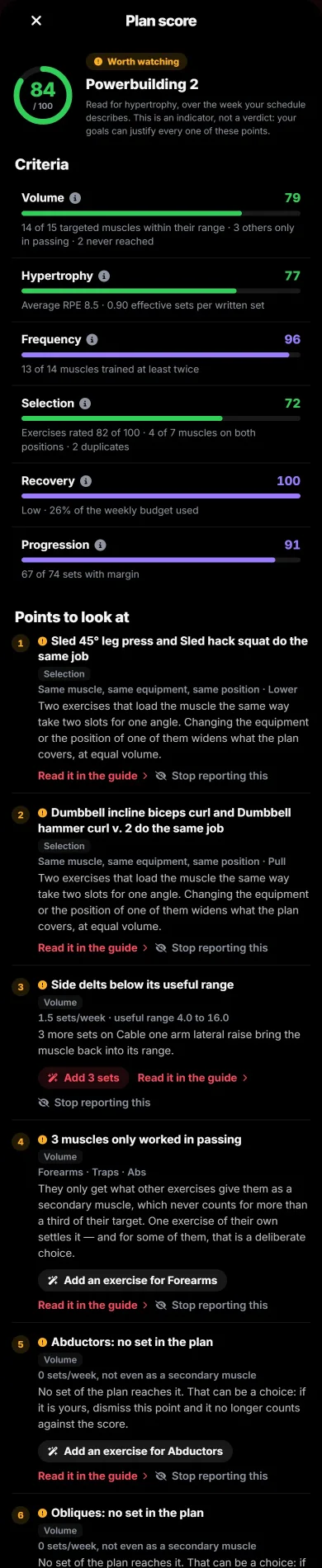
The score shows on the Workout tab for your active program, with its six bars and its points to fix, most urgent first: severity, then the weakest criterion. A point can be dismissed. The program generator writes its draft aiming at this score.
The plan score is part of Liftz Pro. The app is in closed testing on Android; testers get Pro for life, as long as they stay enrolled.
10 Sources
- Pelland et al., 2025
- ACSM, Currier et al., 2026
- Barbalho et al., 2019
- Barbalho et al., 2020
- Refalo et al., 2023
- Refalo et al., 2024
- Schoenfeld et al., 2019
- Remmert et al., 2025
- Maeo et al., 2021
- Maeo et al., 2023
- Kubo et al., 2019
- Kassiano et al., 2022
- Behm et al., 2021
- Robinson et al., 2025
- Kassiano et al., 2026
- Plotkin et al., 2022