 Liftz
How it works
How Liftz picks your next load.
Give an exercise a rep range, say 8 to 12, and log the RPE of your sets: Liftz tells you when the load has become too light or too heavy, and by how much. It is progressive overload, guided by your reps and your RPE.
Published · updated
01 Two readings: reps and RPE
Twelve reps at RPE 6 and twelve at RPE 10 call for opposite next steps. RPE reads as reps in reserve: RPE 10, none; RPE 8, two (Zourdos et al., 2016). Liftz reads both through one number: the reps you would have done at RPE 9, one rep short of failure. Reps at RPE 9 = reps + (9 − RPE). A set without an RPE counts as RPE 9.
At or above the top of the range, at RPE 9: the load has become too light. Below the bottom: too heavy. In between: keep it, and aim for one more rep. The threshold is RPE 9 rather than failure because reaching the top of the range with a rep left says the load is too light, while reaching it at failure only says it is right.
| Set done | At RPE 9 | Verdict |
|---|---|---|
| 12 at RPE 8 | 13 | Top of the range reached: more load |
| 12 without RPE | 12 | Top of the range reached: more load |
| 12 at RPE 10 | 11 | In the range: same load |
| 7 at RPE 9.5 | 6.5 | Below the range: less load |
02 Three moments, three forms
- After a set: a statement under the set, “Top of the range reached” or “Below the range”. It names no load: an order under a finished set, read three months later in your history, would be stale.
- Before a set: what the same set gave last time, matched by its rank on the same exercise in the routine’s previous session, judged against today’s range, with the direction: more or less load. A deload session is not used, it was light on purpose; nor is an exercise whose tempo changed.
- During rest: a load figure for the next set, but only when the set you just did is far from its range: 3 or more reps above the top, or 2 or more below the bottom, at RPE 9, with an RPE of at least 7 logged, and the next set planned at the same load, or with no load yet, as in a program template’s first session. Without a range, the next set’s planned reps are the target. Fatigue costs a rep or two from one set to the next: a set at the top of its range does not mean the next one will be.
03 How the load is calculated
The load aims to put the next set in the middle of its range, at RPE 9. It comes from your 1RM formula (Epley by default), the same curve as your estimates: the reps to failure you did, minus one for the fatigue the next set carries, against those the middle of the range needs. The change is capped at 10 % per set, 5 % of the total load on a bodyweight or assisted exercise; a bigger jump is made over two sets, because the calculation extrapolates. The load is then rounded to what your equipment allows (plates, dumbbells, a machine’s step), towards the load you used: the rounding never goes beyond the calculation.
- 80 kg for 16 reps at RPE 8, range 8 to 12: 17 at RPE 9, 5 above the top. With one rep of fatigue taken off, Epley gives +15 %, capped at +10 %: 88 kg, rounded to 87.5 kg on a barbell loaded with 1.25 kg plates.
- 100 kg for 5 reps at RPE 9, same range: 3 below the bottom. Epley gives −15 %, capped at −10 %: 90 kg.
“Apply” puts that load on the next set and on the identical sets that follow (same exercise, same planned load, same range). Nothing changes by itself, and the advice can be turned off in Settings. On weighted pull-ups or dips, the calculation reads body weight plus the added weight, then gives back the added weight or assistance to set: at +20 kg and 66.8 kg of body weight, the 5 % cap allows +4.3 kg of added weight, not +8.7.
The same calculation for a fresh set, without the fatigue rep or the rounding, is in the free RPE calculator.
04 What the research says, and what Liftz chose
- Reps or load, either works. Adding reps and adding load work about as well: in 43 trained lifters over 8 weeks, under a millimetre of muscle-thickness difference (Plotkin et al., 2022). Double progression, reps first inside a range and then load, is coaching practice: no trial compares the triggers. Liftz’s, the top of the range at RPE 9, is one of them.
- RPE is off, most of all on long sets. Lifters underestimate the reps they have left by about one on average, and by much more beyond 12: the error grows 0.47 reps per rep past that point (Halperin et al., 2022). On a squat of about 16 reps, calling 5 in reserve was off by about 5 reps (Zourdos et al., 2021). That is why the in-session load figure needs a logged RPE of at least 7.
- One rep is worth about 2 % of 1RM at moderate loads (Nuzzo et al., 2024): the 10 % cap is about 4 to 5 reps, the 5 % cap of a bodyweight or assisted exercise about 2 to 3.
- Strength varies from day to day. Repeated 1RM tests vary by a median 4.2 % (Grgic et al., 2020). Liftz judges each session on its own and leaves the call to you: after a set that fell short on a bad day, repeating the load once is a sensible coaching habit, which no trial has tested.
- Choosing the load by RPE rather than fixed percentages gives a small, non-significant strength edge (+2.07 kg; Hickmott et al., 2022), probably because the RPE groups lifted heavier (Helms et al., 2018). Check that your load at a given RPE goes up over time.
05 In the Liftz app
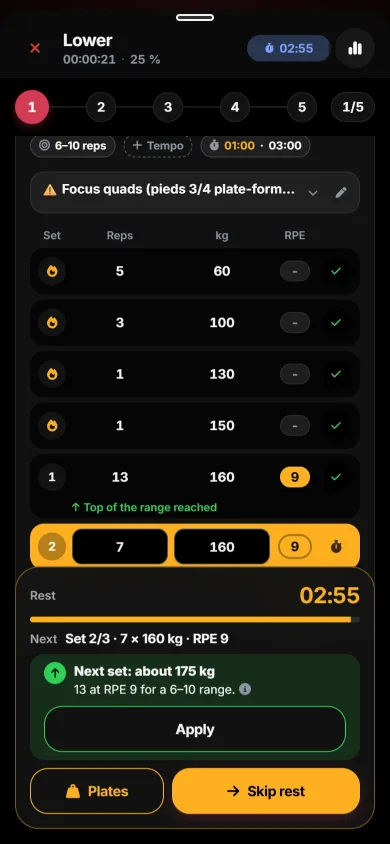
The load advice is free. The rep range goes on an exercise or on a single set (a top set at 3–5 followed by lighter sets at 6–8). The app is in closed testing on Android; testers get Pro for life as long as they stay enrolled.